
Recommended Services


Supported Scripts


The most powerful server plan may be the wrong choice for your community. Knowing how to choose a game server host starts with matching the setup to your game, expected player numbers and preferred level of control, not simply picking the biggest specifications.
It’s reasonable to compare game server hosting, a VPS and a dedicated server while wondering whether Australian infrastructure will make a difference to player latency. A local server can reduce latency for Australian players compared with a distant overseas server, but the result also depends on where players are, their internet provider and network routing.
This guide gives you a practical checklist for comparing hosting models and understanding their trade-offs. You’ll learn what to consider about performance, security, support and pricing, and which questions to answer about your community first. We’ll also explain how Twisted Servers’ Australian Game Server Hosting, VPS Hosting and Dedicated Hosting fit into the decision, so you can choose a setup that suits your needs without paying for control or capacity you don’t require.
Key Takeaways
- To work out how to choose a game server host, start with your game, community size and preferred level of control.
- Compare game server hosting, VPS Hosting and Dedicated Hosting by considering how much setup and administration you’re prepared to manage.
- Australian server location can matter for latency, but player location, ISP and network routing also affect connection quality.
- Assess game compatibility, security protections and support alongside performance claims, and check current requirements for your game.
- Review plan inclusions, management responsibilities and pricing terms to find a setup that fits your community.
How to choose a game server host: start with your game and community
The right host depends on the game you want to run, who will be joining you and how much control you need. A private group with a set play schedule may have different priorities from a public server, gaming clan or growing community. Start with those needs before comparing plans. This helps you avoid paying for features you won’t use or taking on responsibilities that don’t suit your group.
Which game and community are you hosting?
Identify the exact game and edition first. Dedicated server software, availability and requirements can differ between games and versions, so confirm the current details through official developer or publisher sources. A general introduction to What is a Game Server? can also help clarify how a server supports multiplayer play.
Where are your players, and what do they need?
Map where your regular players connect from, including anyone joining from outside Australia. Latency is the delay as data travels between a player’s device and the server. An Australian server can reduce that distance for Australian players compared with a distant overseas server, but it can’t guarantee a particular ping. Latency depends on player location, ISP, routing and server location.
Next, separate essentials from preferences. Decide whether you need to configure the server yourself, want flexibility to change settings, or prefer a more managed setup. Consider how often your group plays and whether you expect it to grow, but don’t assume a particular player count or hardware requirement without checking the game’s current guidance.
- Must-have: the correct game and edition, plus compatible dedicated-server software if the game requires it.
- Management: the access and configuration you want, and how much server administration you’re prepared to handle.
- Preference: a server location that makes sense for where your regular players live.
These answers give you a clearer basis for comparing options. Twisted Servers provides Australian game server hosting, giving local communities an option to consider alongside game compatibility and management needs.
Compare game hosting, a VPS and a dedicated server
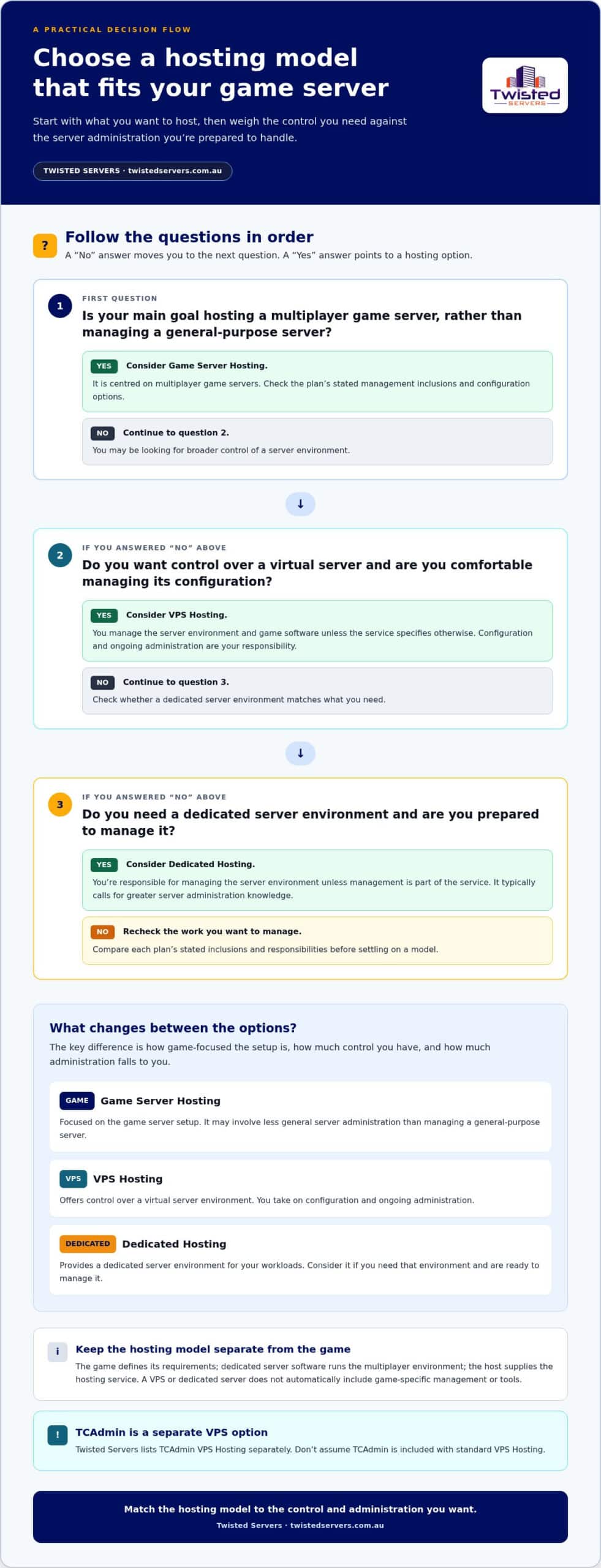
These options differ in how much game-specific setup, control and ongoing administration sit with you. A hosting model is not the same as the game or its dedicated-server software: the game defines its requirements, the server software runs the multiplayer environment, and the host supplies the hosting service. A VPS or dedicated server doesn’t automatically include game-specific management or tools.
| Hosting option | Management | Flexibility | Technical responsibility | Suitable use case |
|---|---|---|---|---|
| Game Server Hosting | Centred on multiplayer game servers; check the plan for its management inclusions. | Focused on the game server setup. | May involve less general server administration than managing a general-purpose server. | Communities prioritising a game-focused hosting option. |
| VPS Hosting | You manage the server environment and game software unless the service specifies otherwise. | Offers control over the virtual server environment. | You take on configuration and ongoing administration. | Users who want a virtual server and are comfortable managing it. |
| Dedicated Hosting | You’re responsible for managing the server environment unless management is part of the service. | Provides a dedicated server environment for your workloads. | Typically calls for greater server administration knowledge. | Communities needing dedicated infrastructure and prepared to manage it. |
When does game server hosting make sense?
Start with this category if your main goal is hosting a multiplayer game server rather than managing a general-purpose server. Before choosing, decide which configuration and maintenance tasks you want to handle yourself, then compare those needs with the plan’s stated inclusions. Our Game Server Hosting page outlines this service.
When should you consider VPS Hosting or Dedicated Hosting?
Consider VPS Hosting if you want control over a virtual server and can take responsibility for its configuration. Dedicated Hosting is a separate option for those seeking a dedicated server environment and able to manage its administration. Neither option automatically supplies game-specific tools or management. Twisted Servers also lists TCAdmin VPS Hosting separately, so don’t assume TCAdmin is included with standard VPS Hosting.
When deciding how to choose a game server host, match the model to the work you’re willing to manage, not just the amount of control it offers. A game-focused service may suit a community seeking a direct route to game server hosting; VPS or dedicated hosting may fit better when broader server control is a priority.
Will an Australian game server host actually reduce lag?
It can help, but it isn’t a guarantee. An Australian server may suit players connecting from Australia because it can reduce the distance their game data travels compared with a server overseas. The result for each player still depends on their location, internet provider, the route their connection takes and the server’s location. Australian hosting may suit Australian players, while individual routes affect results.
How should you assess server location?
Start with the players who regularly join, not just the person organising the server. If most are in Australia, a local hosting location is worth considering. For a community split across Australia and overseas, there may be a trade-off: a location that suits the largest group might mean a longer route for others. No single location guarantees the same experience for everyone.
Before choosing, map where your regular players connect from and decide whose experience matters most. If you move an existing server, compare results from the same players before and after the change where possible. Treat those observations as specific to their connections and routes, not as a promise of what every player will experience.
What can cause lag besides server location?
“Lag” can describe different problems. Latency is network delay between a player and the server. A slow or unstable connection, congestion on a player’s network, or the route taken by their internet provider can affect that delay even when the server is in Australia.
Other symptoms may point to different causes. If several players experience issues at the same time, the server environment or a shared network issue may be involved. If only one player is affected, their connection or route may be a factor. These clues aren’t proof on their own, but they can help narrow down what to investigate. Where the game provides network information, compare what affected players see and note whether the problem happens consistently or at particular times.
Don’t assume that every stutter, delay or disconnection is caused by server location, or that moving the server will fix it. When deciding how to choose a game server host, treat location as one part of the assessment, alongside the connection experience your community reports. Twisted Servers offers Australian game server hosting for communities weighing local infrastructure as part of that choice.
Use this checklist to assess performance, security and support
Claims are easier to compare when you separate what belongs to the game, what comes from its server software and what the hosting provider supplies. Game features are defined by the game, dedicated-server software runs the multiplayer environment, and the host supplies the hosting service and any stated support or security measures. Keep that distinction in mind as you work through this checklist.
- Confirm game fit. Check the current game version and edition, dedicated-server software, required ports, mod compatibility and server requirements against official developer or publisher documentation. Don’t assume a host’s game server service supports every game or configuration.
- Assess location and networking. Compare the server location with where your players connect from. Review the provider’s available information about networking, but treat location and network claims as factors to assess, not a promise of a particular ping.
- Understand management and control. Identify who handles configuration, updates and routine troubleshooting. Clarify which tasks are your responsibility and which are part of the hosting service.
- Review security measures. Look for clearly described protections. Twisted Servers lists DDoS defence, malware scanning and proactive threat management. These measures don’t mean a server is immune to attacks or that every security risk is removed.
- Check support. Consider how you’ll get help when a technical issue affects your community, and whether the support arrangement suits your needs. Twisted Servers provides dedicated expert support available 24/7.
- Read the plan terms. Compare pricing for the specific game and plan you intend to use. Review what the plan says about included resources, management, billing and any additional charges. Don’t infer inclusions from a headline price or assume two plans cover the same tasks.
Which performance and security details are worth checking?
Focus on information that relates to your game and expected use. Look for clear descriptions of networking and resource allocation, then compare them with current requirements from official game sources. A specification without context may not tell you whether the setup suits your needs. Don’t treat performance or protection claims as a guarantee of your own results.
How much support and control will you need?
Be realistic about who will manage server configuration, game updates and routine troubleshooting. More control can also mean more responsibility. If you want Australian game server hosting with dedicated expert support available 24/7, explore Twisted Servers’ Australian game server hosting. These checks make how to choose a game server host a decision based on stated service terms, not assumptions.
Choose your game server host and plan the next step
You’ve compared hosting models and considered how location, management and support affect your community. Now bring those details together. The goal isn’t to select a plan based on a headline claim; it’s to find a service that suits your game and the work you’re prepared to manage.
A practical decision sequence keeps the choice clear:
- Confirm the game and edition. Check that the service you’re considering suits the exact version you plan to run.
- Identify your players. Note where regular players connect from and use that information to assess server location.
- Choose the hosting model. Decide how much control you want and who will take responsibility for configuration and routine administration.
- Compare current service terms. Review the plan details, stated resources, management responsibilities, support and pricing for the option you intend to use.
What should you confirm before choosing a plan?
Use current documentation from the game’s developer or publisher to record its dedicated-server requirements, supported server software, required ports, mod compatibility and update process. These details can change between game versions, so avoid relying on old guides or assuming that a server setup for one edition will suit another.
Then compare that information with the service and plan terms. Keep a short list of requirements alongside the plan details, including any configuration tasks you’ll handle yourself. This helps you spot a mismatch before you commit, without assuming that a service includes particular resources or tools.
When is it time to move from research to hosting?
You may be ready to choose a hosted multiplayer server when you value having it hosted externally and want support as part of your hosting decision. Hosting doesn’t remove every administration task or guarantee uninterrupted play, so be clear about the responsibilities that remain yours. The right balance depends on whether you prefer a game-focused hosting service or greater control with more hands-on technical work.
At Twisted Servers, we provide Australian game server hosting, with dedicated expert support available 24/7. If your game, player community and preferred level of management align with a hosted game server, explore our service details alongside your game’s current documentation to decide whether it’s a suitable next step.
Choose a setup that fits your community
Choosing the right host starts with the game and its current requirements, then moves to where your players connect and how much server administration you want to handle. Compare game server hosting, VPS Hosting and Dedicated Hosting by their stated management, support and plan terms. Australian infrastructure can suit Australian players, but individual latency depends on factors such as location, ISP and routing.
That’s the practical approach to how to choose a game server host: match the setup to your community, check game details against current official documentation and don’t assume a feature or resource is included unless the plan says so. Twisted Servers provides Australian game server hosting, with dedicated expert support available 24/7 and listed security features including DDoS defence.
Ready to compare your options? Explore Australian game server hosting and take the next step with a clearer idea of what your community needs.
Frequently Asked Questions
How do I choose the right game server host?
Choose a host by matching the service to your game, player community and preferred level of control. Confirm the game and edition, check current dedicated-server requirements, then consider where players connect from and how much server administration you want to handle. Compare the plan’s stated resources, support, security and pricing terms. This is a practical way to decide how to choose a game server host without relying on headline claims alone.
Is an Australian game server better for Australian players?
An Australian server may suit Australian players because data can travel a shorter distance than it would to a distant overseas server. It doesn’t guarantee a particular ping or the same experience for every player. Results depend on where each player is, their internet provider, network routing and the server’s location. For communities spread across Australia and overseas, weigh the needs of regular players as a group.
Should I choose game server hosting, a VPS or a dedicated server?
Choose based on how much control you want and what server administration you’re prepared to take on. Game Server Hosting is a game-focused category. VPS Hosting gives you a virtual server environment to manage, while Dedicated Hosting provides a dedicated server environment with its own management responsibilities. A VPS or dedicated server doesn’t automatically include game-specific management or tools, so compare the service terms before deciding.
What should I check before choosing a game server host?
Check that the service suits your exact game and edition, then verify the current dedicated-server software, ports, requirements, update process and mod compatibility using reliable game documentation. Review the plan’s stated resources, server location, management responsibilities, security measures, support and billing terms. Keep game features, server software and host-provided services separate in your comparison. That makes it easier to identify what the game needs and what the plan provides.
Will changing game server hosts fix lag?
Not necessarily. Moving to a server that better suits your players’ locations may reduce the distance data travels, but lag can also relate to ISP routing or a player’s own connection. Server-side performance issues are another possibility. Note who is affected, when the issue happens and whether it’s consistent before deciding on a change. A move may help in some cases, but it can’t guarantee a fix.
How much does game server hosting cost?
Game server hosting costs depend on the game and selected plan. Twisted Servers’ listed overall starting price is From $1.50 AUD/month, but that figure isn’t the price for every game or plan. Compare the current price for your intended game with the plan’s stated resources, management and other terms. Don’t assume similarly priced plans provide the same features or responsibilities.
Does game server hosting include support and security?
Support and security arrangements depend on the service and its stated terms. At Twisted Servers, dedicated expert support is available 24/7. Listed security features include DDoS defence, malware scanning and proactive threat management. These measures don’t guarantee uninterrupted play or immunity from attacks. Also consider who handles game configuration, updates and routine administration, as hosting doesn’t necessarily remove those tasks.
Disclaimer
Game titles, trademarks, logos and related assets are the property of their respective owners. Twisted Servers is an independent hosting provider and is not affiliated with or endorsed by the developers or publishers of the games mentioned unless otherwise stated. Information is provided as a general guide and may change as games, software and hosting services are updated.

