
Recommended Services


Supported Scripts


A reliable Rust community server depends on more than where it’s hosted. Rust server hosting australia is one part of the decision; your players’ locations, server settings and the time you can give to ongoing administration matter too. Australian infrastructure can help reduce the distance data travels for local players, but actual latency also depends on their connection and network routing.
It’s reasonable to want a smooth experience without taking on more technical work than you can manage. Running a server yourself gives you direct control, but you’re also responsible for the hosting environment and routine upkeep. A hosted server can reduce that infrastructure workload, while you focus on the community, rules and gameplay experience.
This guide explains the trade-offs between self-hosting and using a provider, what to consider when choosing settings, and why Rust’s updates and wipe plans belong in your administration routine. You’ll also learn which game-specific details to verify before changing server files or adding custom features. Twisted Servers offers Rust game server hosting with Australian infrastructure and dedicated expert support available 24/7.
Key Takeaways
- Rust server hosting australia can put your community’s server on Australian infrastructure, though player latency still depends on location, ISP and routing.
- Compare hosted servers with self-hosting by considering who manages the infrastructure and how much time you can give to configuration and upkeep.
- Plan server settings around your community, then test changes before making them part of the regular experience.
- Check current Rust documentation before changing server software, maps, mods or administrative settings.
- Twisted Servers lists Rust game server hosting at A$5.00 per month, with Australian infrastructure and dedicated expert support available 24/7.
Rust server hosting in Australia: what it does and who it suits
Rust server hosting is the service of running Rust’s multiplayer server software on connected infrastructure, so players can join the same online world without relying on one player’s gaming session to host it. Rust is the game; server software runs the multiplayer environment; and the hosting service supplies the infrastructure that players connect to. These are related parts, but they aren’t the same thing.
Shared and dedicated hosting describe broad approaches to how hosting resources are allocated. The precise arrangement depends on the service, so the labels alone don’t tell you how a particular server is configured. For a general overview of Rust (video game), see its game history and gameplay background.
What changes when your Rust world runs on a hosted server?
A hosted server can keep the multiplayer environment separate from any one player’s game session. Friends can connect to the same server at different times while it’s running, rather than depending on a participant to host from their own device. Hosting the environment doesn’t decide the game’s rules or settings: those relate to Rust and its server software, while the hosting service provides the infrastructure.
That separation can also change who handles the technical workload. With hosted Rust server hosting, the provider manages the hosting infrastructure, while you remain responsible for community choices such as who can play and how you want the server experience organised. The exact division of tasks depends on the service.
When does Australian Rust server hosting make sense?
Australian infrastructure may suit a group whose players are mainly in Australia because a shorter network route can reduce latency compared with connecting to a distant overseas server. Latency is the time data takes to travel between a player’s device and the server. It affects how responsive the connection feels, but location alone can’t predict each player’s result.
Player location, their internet service provider (ISP), network routing and server location all influence latency. Players spread across Australia may also have different connection experiences. An Australian location is a sensible factor to consider for a local community, not a promise of a particular ping.
This setup can suit friends wanting a shared world, community groups building a regular place to play, or organisers who want the server environment separate from their own gaming session. If you’re weighing up location and other hosting considerations, read our Australian game server hosting information.
How Rust hosting, the game server and player connections fit together
Think of a Rust multiplayer session as three connected parts: each player runs a Rust client, dedicated-server software manages the shared game world, and hosting infrastructure runs that software and connects it to players. The client sends player actions to the server, which processes the shared state and sends updates back. If one part is misconfigured or a connection is unstable, players may experience problems even when the other parts are working normally.
These layers have different responsibilities. Rust defines the game; dedicated-server software provides the tools and settings for running a multiplayer environment; and the hosting provider supplies the infrastructure and the hosting services included in its plan. A game’s general capabilities don’t automatically mean a particular host supports every server setting, mod or management feature. For details about our Australian game server hosting, see the service information.
What affects connection quality for Australian Rust players?
Latency is the time it takes for information to travel between a player’s device and the server. Distance is one factor: Australian infrastructure may shorten the route for players connecting from Australia compared with a server far away. It can’t guarantee low latency or the same experience for everyone.
Each player’s internet connection and ISP, the route their traffic takes, and the server’s location all matter. This means two players joining the same Rust world may have different connection quality. The broader local games sector is covered in the Australian Game Developer Survey from IGEA and Screen Australia, though it doesn’t determine an individual player’s route or connection.
Which Rust server details need checking before setup?
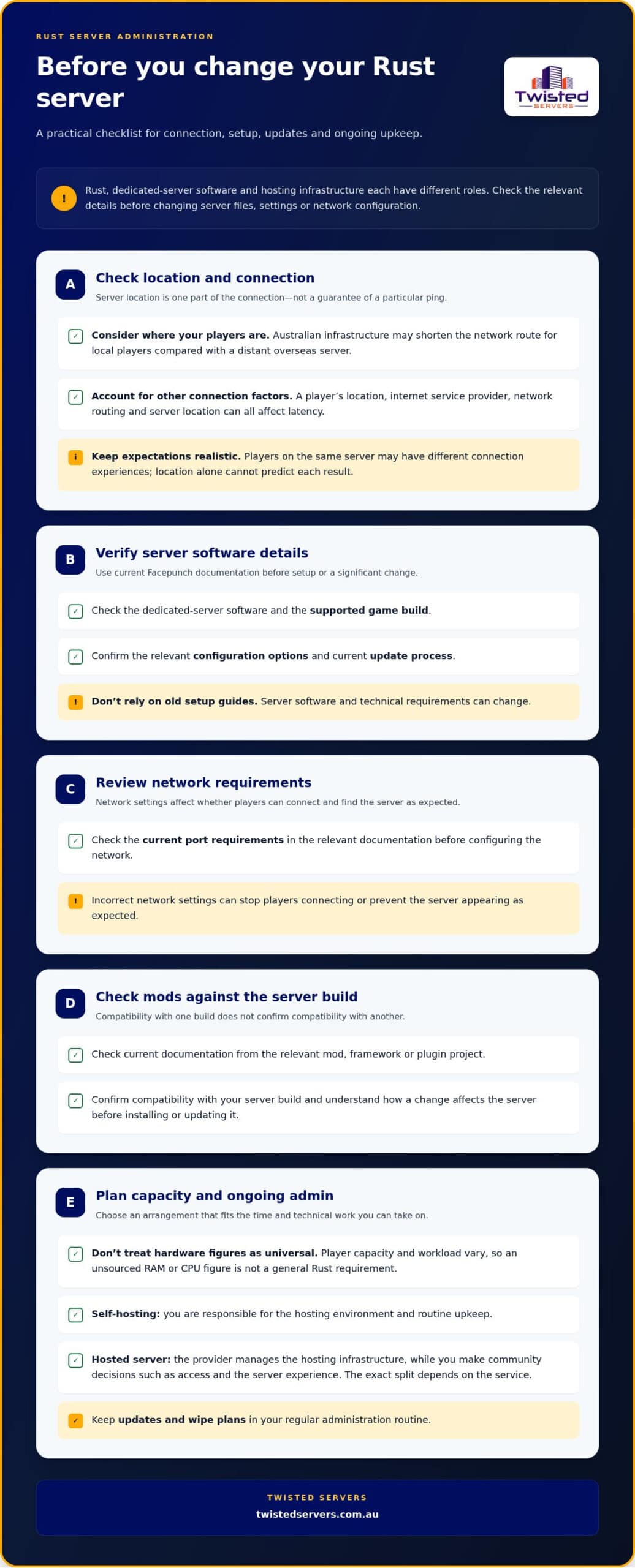
Rust’s server software and technical requirements can change. Before setup or a significant change, check current Facepunch documentation for the dedicated-server software, supported game build, configuration options and update process. Consult current documentation for port requirements too; don’t rely on old setup guides, since incorrect network settings can prevent players from connecting or the server from appearing as expected.
Mods require particular care. A framework or plugin working with one server build doesn’t establish that it’s compatible with another. Check current documentation from the relevant project and confirm how changes affect your server before installing or updating anything. Apply the same discipline to hardware recommendations: player capacity and workload vary, so don’t treat an unsourced RAM or CPU figure as a universal Rust requirement.
For a practical next step, explore Twisted Servers’ game server hosting alongside your community’s technical needs.
Hosted Rust server versus self-hosting: compare the ongoing responsibilities
The main trade-off is who looks after the infrastructure, not who makes every decision about the game world. Self-hosting gives you direct responsibility for the machine and its connection. With hosted Rust server hosting, the provider manages the hosting infrastructure, while your role in configuration and administration depends on the service and the controls it provides.
- Infrastructure: When self-hosting, you maintain the host machine and its network connection. With a hosted server, the provider manages the hosting infrastructure covered by its service.
- Configuration: Self-hosting means you handle the server software and the settings you choose. With hosted services, administration still involves server and community decisions, while the available tools and division of tasks vary by service.
- Routine upkeep: Self-hosting leaves you responsible for maintaining the system, applying relevant updates and troubleshooting issues. A hosted service takes on infrastructure management, but server administration and upkeep still depend on what the service covers.
What do you manage when self-hosting Rust?
You’re responsible for keeping the host machine and its connection available, maintaining the server software and investigating problems. Availability and performance depend on the system you run and the network between it and your players. There’s no universal hardware specification to apply without checking current, reliable requirements for your intended setup.
What can hosted Rust server hosting take off your plate?
A hosted service can shift responsibility for the hosting infrastructure away from you, but it doesn’t automatically make every game-world decision or handle every administrative task. You still need to plan the community experience and manage the settings and routines that fall within your role. Twisted Servers offers Rust game server hosting on shared and dedicated servers, Australian infrastructure and dedicated expert support available 24/7.
The right option depends on how much time you can give to machine and network upkeep, how much direct control you want, and what your community needs. Choosing Rust server hosting australia may suit organisers who’d rather not maintain the hosting machine themselves; self-hosting may suit those comfortable taking on that work. Explore our game server hosting to see how a hosted setup fits alongside your administration responsibilities.
Rust server setup and upkeep: plan configuration, updates and troubleshooting
A stable Rust server starts with a plan, not a string of settings copied from an old guide. Decide what experience your community wants, check current technical information, configure the server, test it with a small group, then set a routine for updates and maintenance. This makes changes easier to assess and helps you spot problems before they affect the wider community.
What should you decide before opening a Rust server to players?
Start with your community’s expected activity and preferred play style. A small group of friends may want different rules from an organised community, so agree on the experience you’re aiming to create before choosing settings. Avoid picking a player capacity based on a general recommendation; requirements depend on the actual setup and should be checked against reliable, current information.
Next, confirm the current Rust dedicated-server documentation for available settings, maps, administrative functions and any mods you plan to use. These details can change, and a setting or add-on described in an older guide may no longer work as expected. Once configured, test the server before inviting everyone. Tell players what rules and settings to expect, especially if they differ from the experience they may be used to.
How can admins approach routine updates and connection problems?
Make maintenance predictable. Check current official Rust update information, plan changes around your community’s play schedule and let players know if an update or configuration change may affect access. Keep a simple record of what you changed and when. If an issue appears afterwards, that record gives you a clear starting point for investigating, rather than relying on memory.
Start troubleshooting with the symptom, then gather evidence before changing settings. First establish whether the issue affects one player or the whole community. If it’s limited to one person, compare their connection and the exact error with another player’s experience. If several players report the same issue, check whether the server is running and look for recent server-side changes or relevant error information. Change one thing at a time, then test again so you can tell whether it helped.
Keep separate track of the server software, game updates and any added configuration or mods. Check compatibility against current documentation before applying changes, and don’t assume a hosting provider automates updates or troubleshooting unless that’s part of the stated service. With Rust server hosting Australia, your maintenance routine should reflect both the tools available and the time you can give to administration. Explore Rust game server hosting as one option for running your community server.
Choosing Australian Rust server hosting: what Twisted Servers offers
A good hosting choice should fit both your community and the amount of server administration you want to handle. Twisted Servers offers Rust game server hosting on shared and dedicated servers for multiplayer gaming, with Australian infrastructure and dedicated expert support available 24/7. The Rust catalogue listing is A$5.00 per month.
Australian infrastructure can be relevant if your community is based here, as server location affects the distance player data travels. It doesn’t guarantee a particular ping: each player’s location, internet service provider and network routing also affect their connection. Consider where your players are based and what kind of server experience you’re planning before choosing a hosted setup.
What can you expect from Twisted Servers Rust hosting?
Hosting provides the infrastructure for your Rust server, while the server’s settings and community decisions shape the experience you create. Twisted Servers’ confirmed offer includes shared and dedicated game servers, Australian infrastructure and dedicated expert support. These details don’t imply particular hardware, player capacity, control-panel functions or mod support.
Listed security features include DDoS defence and Arista Edge Threat Management. These are security measures, not a promise that a server will never experience disruption. For connection quality, results still vary according to player location, ISP, routing and the server’s location.
What is a sensible next step for your Rust community?
Before settling on a setup, write down what your community needs: the style of play you want, who will manage the server’s settings and how much time you can give to routine administration. Review current Rust documentation for server requirements and configuration options, particularly if you plan to make changes or add custom features. This gives you a clearer basis for assessing whether hosted Rust server hosting suits your plans.
If you’re organising an Australian community and want to explore a hosted option, visit our Australian Rust game server hosting page for details.
Build a Rust server that fits your community
A reliable Rust community server starts with a setup that suits your players and the time you can give to administration. Hosting in Australia may help reduce the distance for local players, but connection quality also depends on each player’s location, ISP and network routing. Choose between self-hosting and a hosted service based on how much infrastructure you want to manage, then check current Rust documentation before changing server settings, software or mods.
Twisted Servers is an Australian hosting provider offering Rust game server hosting, with a listed price of A$5.00 per month and dedicated expert support available 24/7. Rust server hosting australia can be a practical option if you want hosting infrastructure managed separately from your community’s game-world decisions.
Ready to consider a hosted setup? Explore Rust server hosting in Australia and take the next step towards a server plan shaped around your community.
Frequently Asked Questions
What is Rust server hosting?
Rust server hosting runs multiplayer server software on infrastructure that players connect to, creating a shared game environment separate from an individual player’s session. The game provides Rust’s gameplay; dedicated-server software runs the multiplayer world; and the hosting service supplies the infrastructure. As the administrator, you plan how the community will use the server and manage the settings and upkeep assigned to you.
Is Australian Rust server hosting better for Australian players?
Australian Rust server hosting may suit a group whose players are mainly in Australia because local infrastructure can reduce the distance data travels compared with a distant overseas server. That can be relevant to connection quality, but it doesn’t make every player’s connection the same. Player location, their internet service provider, network routing and server location all affect latency, so consider where your community is based without expecting a particular ping.
Can I host a Rust server on my own computer?
Yes, you can run a server on a computer you manage, provided you set it up to run the required server software and make it reachable by players. You’ll also take responsibility for the machine, its network connection, software maintenance and troubleshooting. Availability and performance depend on your system and connection. Check current official Rust documentation for setup and technical requirements before choosing this approach.
What do I need to check before setting up a Rust server?
Start with current official Rust documentation. Check the dedicated-server software, supported game build, system requirements, network ports, configuration options and update process. If you plan to use maps, administrative functions or mods, verify their current setup instructions and compatibility as well. Requirements can change, so avoid relying on old guides or unsourced RAM, CPU or player-capacity recommendations when planning your server.
Does an Australian Rust server guarantee low ping?
No. An Australian server can reduce the distance to players in Australia, but it can’t guarantee a particular ping or connection quality. Each player’s location, internet service provider and connection, plus the route traffic takes to the server, affect latency. Players in the same community may therefore have different experiences. Treat server location as one useful planning factor, not a promise of identical performance for everyone.
How much does Rust server hosting with Twisted Servers cost?
Twisted Servers lists Rust game server hosting at A$5.00 per month. The service is offered by an Australian hosting provider, and dedicated expert support is available 24/7. Review the hosting details alongside your community’s needs and the Rust server administration you expect to handle. The listed price alone doesn’t specify player capacity, hardware or included configuration options, so don’t assume those details from the price.
Can I use mods on a Rust server?
Mod use depends on current Rust server compatibility, the relevant mod framework and the hosting setup. Before planning a modded experience, check the framework’s current documentation and the instructions for each mod, including whether they work with the server build you intend to run. Don’t assume a particular host includes mod installation or support. Test changes before making them part of the regular experience for your players.
Who handles Rust server updates and configuration?
It depends on whether you self-host or use a hosted service, and on what that service includes. With self-hosting, you manage the machine, server software and updates. Hosting can shift infrastructure management to the provider, but administrators still need to make community and game-world decisions. Before updating, check current Rust information, consider your players’ schedule and keep a record of configuration changes so you can investigate issues methodically.
Disclaimer
Game titles, trademarks, logos and related assets are the property of their respective owners. Twisted Servers is an independent hosting provider and is not affiliated with or endorsed by the developers or publishers of the games mentioned unless otherwise stated. Information is provided as a general guide and may change as games, software and hosting services are updated.

