
Recommended Services


Supported Scripts


A free SSL certificate doesn’t mean your web assets are safe from a targeted breach. When evaluating secure web hosting Australia businesses can genuinely rely on, you have to look beyond surface-level security badges and examine the actual perimeter hardware shielding your servers. You likely already share the frustration of vague provider claims that mask weak account isolation, leaving your applications vulnerable and complicating your compliance under the Australian Privacy Act.
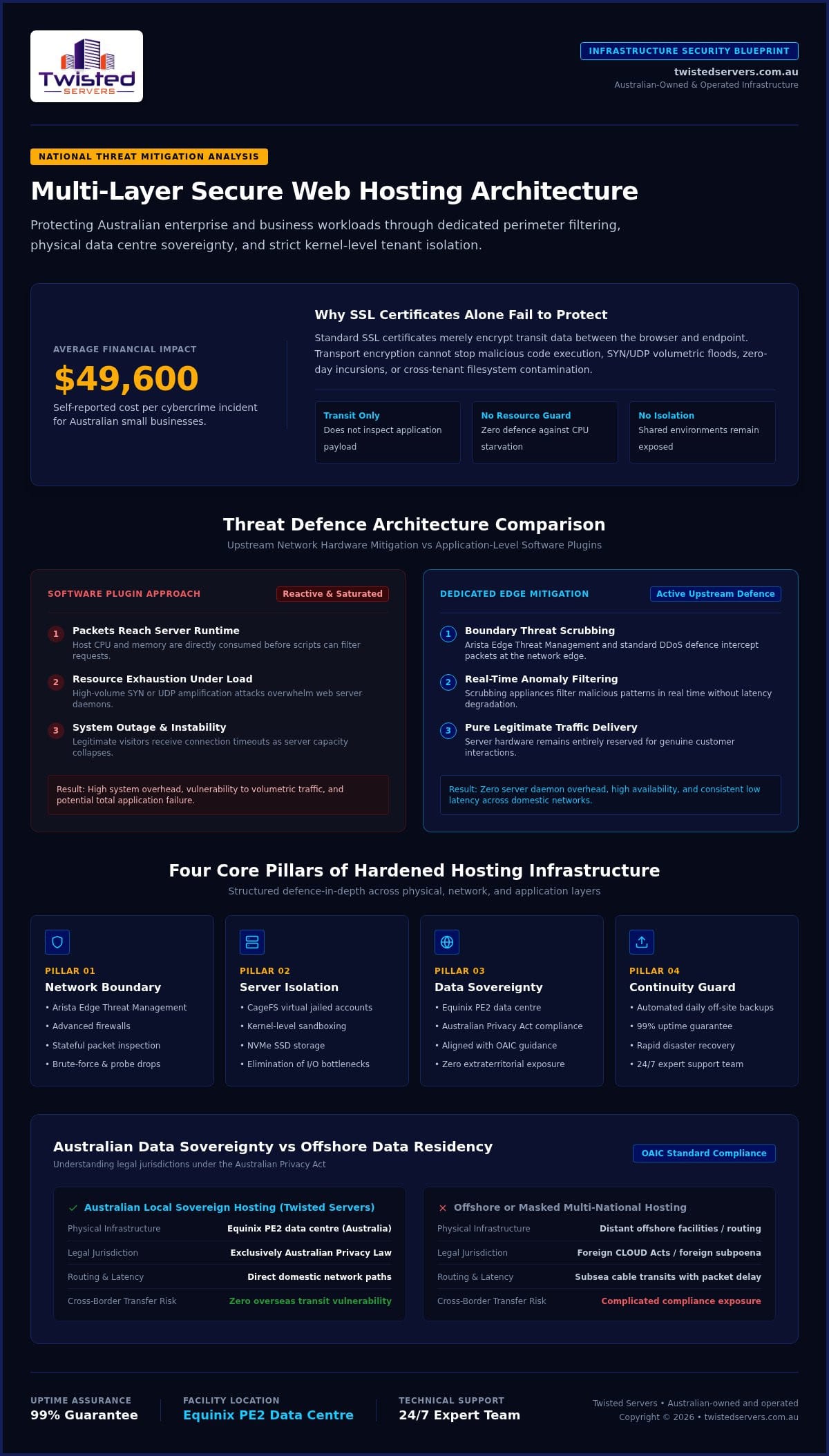
With self-reported cybercrime costs for Australian small businesses averaging $49,600 per incident, your platform needs active mitigation rather than passive checkboxes. In this guide, you’ll learn how to protect your web applications using local infrastructure, active threat management, and hardened hosting architectures. We preview the technical benchmarks, data sovereignty requirements, and reliable backup protocols essential for keeping your Australian web assets defended in 2026.
Key Takeaways
- Move beyond standard SSL certificates by implementing layered perimeter defence and active runtime monitoring across all infrastructure levels.
- Discover why dedicated hardware mitigation outclasses reactive software plugins when evaluating secure web hosting Australia businesses rely on for threat defence.
- Understand the vital distinction between Australian data sovereignty and simple offshore data residency to keep customer records compliant under national privacy laws.
- Apply a structured five-step hosting audit framework to enforce least-privilege access and harden production server environments.
- Assess your technical risk profile to choose the right hosting tier across web hosting, VPS, or dedicated server architectures.
Core Pillars of Secure Web Hosting in Australia
True hosting defence is built like a vault, operating across distinct physical, network, and application boundaries. While many offshore providers treat security as a simple checkbox consisting of an SSL certificate and automated script updates, an effective security architecture requires deliberate hardening from the physical server rack up to the web application runtime. Exploring web hosting security fundamentals shows that transport encryption merely secures transit data; it does nothing to prevent malicious code execution, zero-day incursions, or cross-tenant contamination.
Australian businesses must scrutinise a provider’s underlying infrastructure rather than rely on dashboard marketing claims. Deploying workloads on domestic hardware gives you direct control over latency paths and ensures your operational assets operate within Australia’s rigorous regulatory framework. At Twisted Servers, our web hosting infrastructure combines local data centre facilities with active threat controls to safeguard critical business workloads from evolving digital threats.
Essential Perimeter Security and Advanced Firewalls
Perimeter defence acts as your first barrier. It intercepts incoming traffic, inspecting web requests thoroughly before they reach the web server daemon. Rather than waiting for your application code to handle malformed packets, edge appliances filter malicious signatures and automated probe bots at the network boundary.
We deploy advanced firewalls and stateful packet inspection to monitor connection states dynamically across public endpoints. This architecture actively terminates brute-force attempts and drops unauthorised protocol sweeps instantly. By offloading malicious traffic at the perimeter, your server resources remain dedicated to genuine customer traffic.
Server-Level Isolation and Resource Protection
Multi-tenant environments require strict boundaries to prevent a single compromised website from endangering adjacent accounts. Without kernel-level sandboxing, a local file inclusion exploit on an unrelated site can expose system directories across the entire server machine.
Our secure web hosting Australia platform prevents cross-account infection using isolated environments like CageFS. This encapsulates each user into a secure virtual jail, restricting visibility so tenants cannot view system processes, configuration files, or other client data. Paired with high-performance NVMe SSD storage, this architecture prevents input/output bottlenecks, maintaining filesystem stability and strict data integrity under severe traffic spikes.
Evaluating Threat Defence: DDoS Mitigation and Malware Scanning
Relying on software plugins to protect production servers creates a dangerous false sense of security. Application-level security scripts only execute after an incoming connection reaches your web server stack, consuming valuable memory and CPU cycles before filtering a single request. When high-volume automated attacks strike, software-based firewalls quickly buckle under the resource strain, dragging your site offline. Effective risk reduction demands dedicated upstream hardware mitigation that neutralises threats before bad packets ever reach your application layer.
Understanding these infrastructure realities aligns directly with the OAIC’s Guide to Securing Personal Information, which directs organisations to implement reasonable technological safeguards against malicious interference. Evaluating secure web hosting Australia options means looking past expensive checkout add-ons and choosing hosts that build upstream protection into the network foundation.
Edge Threat Management Against Volumetric Attacks
Volumetric DDoS attacks against Australian online services frequently combine SYN floods, UDP amplification, and application-layer request spikes to overwhelm network transit capacity. We counter these complex attack profiles by deploying Arista Edge Threat Management and standard DDoS defence at the network boundary.
This edge architecture continuously analyses live traffic patterns across our domestic network fabric. When an anomaly triggers an alert, scrubbing appliances isolate and filter malicious streams in real time. Legitimate visitor requests pass through uninterrupted without latency degradation, keeping your storefront or web application fully operational during major attack campaigns.
Automated Malware Scanning and Proactive Threat Removal
Static signature scanners run on arbitrary schedules, often finding malicious injections days after an initial compromise. Proactive threat management monitors file execution and system calls dynamically to detect unexpected behavioural anomalies, backdoors, and web shells immediately.
Automated isolation workflows immediately quarantine suspect code in real time before it can taint production databases or infect customer sessions. This proactive containment preserves core site availability and protects visitor trust while remediation runs quietly in the background.
If your team requires dedicated compute power with isolated network boundaries, our unstoppable VPS hosting provides full root access alongside upstream threat filtering to keep your workloads resilient.
Australian Data Sovereignty and Privacy Compliance Standards
Data sovereignty means your records remain exclusively subject to Australian laws and legal protections. Storing sensitive customer data offshore exposes your business to foreign jurisdiction mandates, such as the US CLOUD Act, which can compel overseas entities to surrender data regardless of where you operate. For organisations prioritising secure web hosting Australia facilities provide legal certainty by ensuring all files, user databases, and transaction records stay within our domestic regulatory perimeter.
Operating entirely on Australian-owned and operated infrastructure eliminates ambiguous third-party handling. When you partner with Twisted Servers, your application environments are anchored in local infrastructure, helping you meet the strict compliance requirements demanded by domestic enterprises, public sector entities, and everyday consumers.
The Security Advantages of Local Infrastructure
Housing your workloads locally offers profound security and operational gains. Domestic routing ensures traffic flows directly through local exchanges, dramatically cutting transit hops and minimising the risk of upstream interception along international undersea cables.
Physical facility controls matter just as much as digital firewalls. We maintain our primary hardware inside premier domestic facilities, including the Equinix PE2 data centre. This environment delivers high-level physical defence, including multi-factor biometric authentication, 24/7 on-site security patrols, and continuous CCTV surveillance. This tight operational control simplifies your third-party security audits and gives you peace of mind regarding the physical custody of your data.
Meeting Australian Privacy Principles and Data Regulations
Australian Privacy Principle 11 (APP 11) legally mandates that organisations take active, reasonable steps to protect personal information from misuse, interference, loss, and unauthorised access. Failing to secure stored records can trigger severe consequences under the Notifiable Data Breaches (NDB) scheme, where organisations must notify affected individuals and the Australian Information Commissioner of eligible breaches.
Deploying your systems on domestic bare metal or isolated instances simplifies compliance significantly. Our hardened dedicated server hosting Australia options provide single-tenant isolation, automated daily off-site backups, and strict local containment. This foundation ensures that when auditors review your data lifecycle, your posture satisfies the highest benchmarks of Australian privacy law.
Five Critical Steps to Audit and Harden Web Hosting
Securing production workloads demands a structured operational framework rather than occasional, ad-hoc adjustments. Basic password updates barely scratch the surface of your attack surface. To maintain a resilient posture across secure web hosting Australia environments, system administrators must follow a methodical hardening sequence:
- Enforce least-privilege identity access: Restrict administrative rights to verified personnel and disable unnecessary elevated roles.
- Implement cryptographic authentication: Replace all password-based administrative entry points with hardware-backed SSH keys.
- Isolate network listener ports: Close remote database listener ports to public interfaces, forcing connections through encrypted local sockets or secure VPN tunnels.
- Automate segregated off-site backups: Maintain encrypted, out-of-band data snapshots completely detached from the primary hosting account.
- Execute routine integrity tests: Perform scheduled recovery drills and configuration checksum audits to detect unauthorized modifications immediately.
Reviewing Access Controls and Administrative Privileges
Granting blanket Root Access across production web environments introduces massive operational risk. A single compromised script running under root execution compromises the entire operating system, bypassing software barriers instantly. Administrators should operate under restricted accounts, elevating privileges only through strictly audited commands.
Eliminate standard password authentication across all remote access vectors. Enforcing public-key SSH authentication terminates credential-stuffing campaigns immediately. Staging environments and development repositories must sit on completely separated file partitions with distinct credentials, ensuring code testing never exposes live databases to vulnerabilities.
Configuring Automated Daily Off-Site Backups
Local snapshots stored on the same physical volume provide zero protection against aggressive ransomware or catastrophic filesystem failures. If an attacker breaches the root account, local backup partitions are the first targets deleted or encrypted. Effective continuity requires air-gapped isolation.
Twisted Servers incorporates automated daily off-site backups into our infrastructure baseline, storing snapshots in physically segregated secondary storage repositories. This operational structure prevents lateral movement attacks from tampering with recovery points.
Scheduling automated snapshots is only half the battle. Your operational team must regularly run restoration drills in staging sandboxes, verifying database integrity and testing recovery times to eliminate guesswork during an emergency. If your current host treats basic data preservation as an expensive upsell, contact Twisted Servers to audit your architecture and migrate your applications to hardened Australian hosting.
Selecting the Right Tier of Secure Hosting for Australian Workloads
Matching architectural tiers to your specific risk profile is critical when engineering a resilient online platform. Selecting the right tier of secure web hosting Australia businesses deploy depends directly on threat exposure, data sensitivity, and expected traffic volume. A brochure site displaying business hours carries fundamentally different operational risks than an e-commerce platform processing thousands of domestic customer transactions every week.
Scaling safely means choosing an environment where security controls expand alongside your traffic, ensuring rapid growth never introduces unexpected vulnerabilities into your operating stack.
Shared Web Hosting Versus Isolated VPS Environments
Hardened shared web hosting serves as a dependable, budget-conscious baseline for small business websites, community portals, and standard digital footprints. When properly configured with containerised accounts and perimeter filtering, shared environments provide strong baseline defence against common automated scripts and bot scrapers.
When your platform manages customer databases, user portals, or sensitive business records, transitioning to unstoppable VPS hosting provides hypervisor-level isolation. A virtual private server grants dedicated kernel autonomy, preventing adjacent workloads from consuming your processing power or exposing your memory space. This performance isolation stops noisy-neighbour resource starvation, ensuring your security daemons and applications run continuously even when other tenants face massive traffic surges.
Dedicated Infrastructure for High-Security Enterprise Workloads
Regulated industries, high-volume transactional platforms, and public sector workloads frequently face compliance standards that prohibit multi-tenant infrastructure altogether. In these situations, deploying single-tenant dedicated server hosting gives your enterprise complete physical custody of bare-metal hardware within Australian data centres.
We configure custom built servers designed around your specific operating parameters, supporting tailored network configurations, dedicated hardware firewall rules, and custom storage arrays. Meanwhile, businesses maintaining large content footprints can turn to managed WordPress hosting, which unites application-layer hardening and isolated database configurations without requiring manual system administration.
Whatever tier your workload requires, our team is on hand 24/7 to provide technical guidance, helping you deploy a hardened hosting environment that keeps your web assets protected and fully compliant under Australian law.
Future-Proof Your Digital Assets with Hardened Domestic Hosting
Relying on basic security add-ons is no longer viable when running business-critical systems. Genuine operational resilience demands layered isolation, verified data sovereignty within domestic borders, and active mitigation instead of reactive remediation. Choosing secure web hosting Australia organisations trust means anchoring your infrastructure in hardware-backed boundaries that neutralise malicious traffic before it ever touches your application stack.
Twisted Servers pairs Australian-owned and operated infrastructure with Arista Edge Threat Management perimeter protection, ensuring your workloads remain fast, compliant, and continuously defended against emerging threats. Supported by automated daily off-site backups and dedicated expert support available 24/7, you don’t have to navigate technical security complexities alone. Take control of your operational security today: Protect your web presence with secure Australian web hosting and give your enterprise the lasting reliability it deserves.
Frequently Asked Questions
What makes web hosting truly secure in Australia?
Truly secure hosting combines physical domestic infrastructure, upstream hardware threat mitigation, kernel-level tenant isolation, and strict adherence to Australian privacy legislation. It goes beyond cosmetic software add-ons by stopping attacks at the network edge. When sourcing secure web hosting Australia businesses must ensure their provider enforces active threat management and isolated storage rather than relying solely on surface-level control panel dashboards.
Is a free SSL certificate enough to secure my website?
No, an SSL certificate only encrypts data travelling between the visitor’s browser and the web server. It doesn’t prevent web shell execution, SQL injection attacks, or brute-force incursions targeting administrative panels. While transport-layer encryption is mandatory for modern privacy, true protection requires server-level isolation, advanced firewalls, and active malware inspection to protect core database assets and underlying application files.
Why does server location matter for cybersecurity and compliance?
Server location dictates both legal jurisdiction and network vulnerability. Hosting data domestically ensures customer records are governed exclusively by the Australian Privacy Principles rather than extraterritorial foreign laws like the US CLOUD Act. Local routing also reduces international transit hops across undersea cables, lowering latency while minimising points where traffic could be intercepted or delayed during volumetric distributed attacks.
How does hardware DDoS mitigation differ from software firewalls?
Hardware mitigation neutralises malicious traffic at the upstream network edge before packets can touch the physical server rack. Software firewalls run on the server operating system, meaning they must process packets using your host CPU and RAM. During large volumetric floods, software firewalls quickly exhaust system resources and crash your site, whereas hardware filtering scrubs anomalous traffic seamlessly without introducing latency.
What is the security difference between shared hosting and a VPS?
Shared hosting groups multiple users on a single operating system, relying on software-level jail environments like CageFS to restrict visibility. A virtual private server (VPS) provides complete hypervisor isolation with dedicated virtualised hardware and its own kernel. For organisations running secure web hosting Australia workloads, a VPS eliminates noisy-neighbour performance degradation and guarantees that a compromised adjacent tenant cannot access your system memory or processes.
How frequently should production websites be backed up?
Production environments should be backed up at least once daily, with snapshots transmitted to an isolated off-site repository. Storing backups on the local host leaves them vulnerable if ransomware or a malicious attacker gains root access. We maintain automated daily off-site backups on physically separated storage. This ensures you can restore uncompromised database records and core application directories rapidly without negotiating with attackers.
What role does Arista Edge Threat Management play in site security?
Arista Edge Threat Management inspects network traffic patterns dynamically at the perimeter before incoming requests reach server endpoints. It identifies emerging threat anomalies, blocks protocol abuse, and filters multi-vector DDoS floods automatically. By offloading malicious request handling to specialised perimeter hardware, your hosting environment preserves compute resources for legitimate visitors, maintaining dependable uptime and site responsiveness during ongoing attack campaigns.
Disclaimer
Game titles, trademarks, logos and related assets are the property of their respective owners. Twisted Servers is an independent hosting provider and is not affiliated with or endorsed by the developers or publishers of the games mentioned unless otherwise stated. Information is provided as a general guide and may change as games, software and hosting services are updated.

