
Recommended Services


Supported Scripts


A .com.au address is only one option for domain registration in Australia. A domain name is the address people use to find a website online, and the extension at the end helps identify the type of domain. Choosing one starts with understanding what each option is for and who can register it.
It’s easy to assume that finding an available name is the main step in domain registration in Australia. The extension and your eligibility matter too, especially when choosing between .au, .com.au and other Australian domains.
This guide explains the available domain extensions, what you need to register one, and how eligibility varies. It also covers domain pricing, so you can weigh the key considerations before registering a name for your business, organisation or personal project.
Key Takeaways
- Choose a domain name that is easy to spell and recognisable as your business or brand.
- Check which Australian domain extension suits your purpose, as each has different eligibility requirements.
- Prepare the relevant Australian business or organisation details before starting a .au registration.
- Compare first-year costs by extension and registration period, and account for renewal when planning your budget.
- Twisted Servers offers domain name registration alongside hosting options, so you can bring your domain and hosting needs together.
What do I need to register .au domain names?
A business can have a business name without owning the matching domain. Registering a domain gives customers a consistent web address to remember and enter. It can also support email addresses that match the business identity. For example, Harbour Repairs could use its name in both its website address and customer email. Registering before the website launches can reserve the name for when the site is ready.
Start with the name customers already know. A domain that closely matches your business name or brand can make your online presence easier to recognise. Keep it short and easy to spell. Say it aloud and ask whether someone could type it correctly after hearing it once. Avoid names that could be confused with another brand.
Next, search for the proposed name using the .au Domain Administration Ltd (.auDA) search. Treat this as an availability check, not proof that the name is safe to use. Domain registration in Australia gives you the address, not intellectual property protection. If another party has trade marked the name, using it could lead to legal action. Register your business name first and consider trade mark protection when planning your online identity.
Before committing, compare a shortlist of candidate names against your business’s public identity. A name that works on a sign or invoice may still look awkward in an email address. Check that it is readable without spaces and consider whether customers could mistake one word for another. These practical tests help narrow your options before you apply.
For a government organisation, choose a name that clearly identifies the public entity it represents. A department or council should consider whether the address will be recognisable to people seeking its services. Avoid wording that could make the site appear to represent another agency. Choose a name that reflects the organisation’s established identity, rather than a campaign or temporary project.
An existing domain may also need administrative updates after registration. For an existing gov.au domain, use a service request form to add or remove name servers, or amend Whois contact details. The Domain Administration Helpdesk processes these requests. Keep the contact details current so the responsible organisation can manage its domain records.
Once the name is chosen, domain registration in Australia can be a step before website setup, rather than something that must wait for launch. Domain name registration lets you move from a shortlist to securing the address. Choose the name with your long-term business identity in mind, then provide the details required for the selected domain.
Eligibility for Australian domain extensions
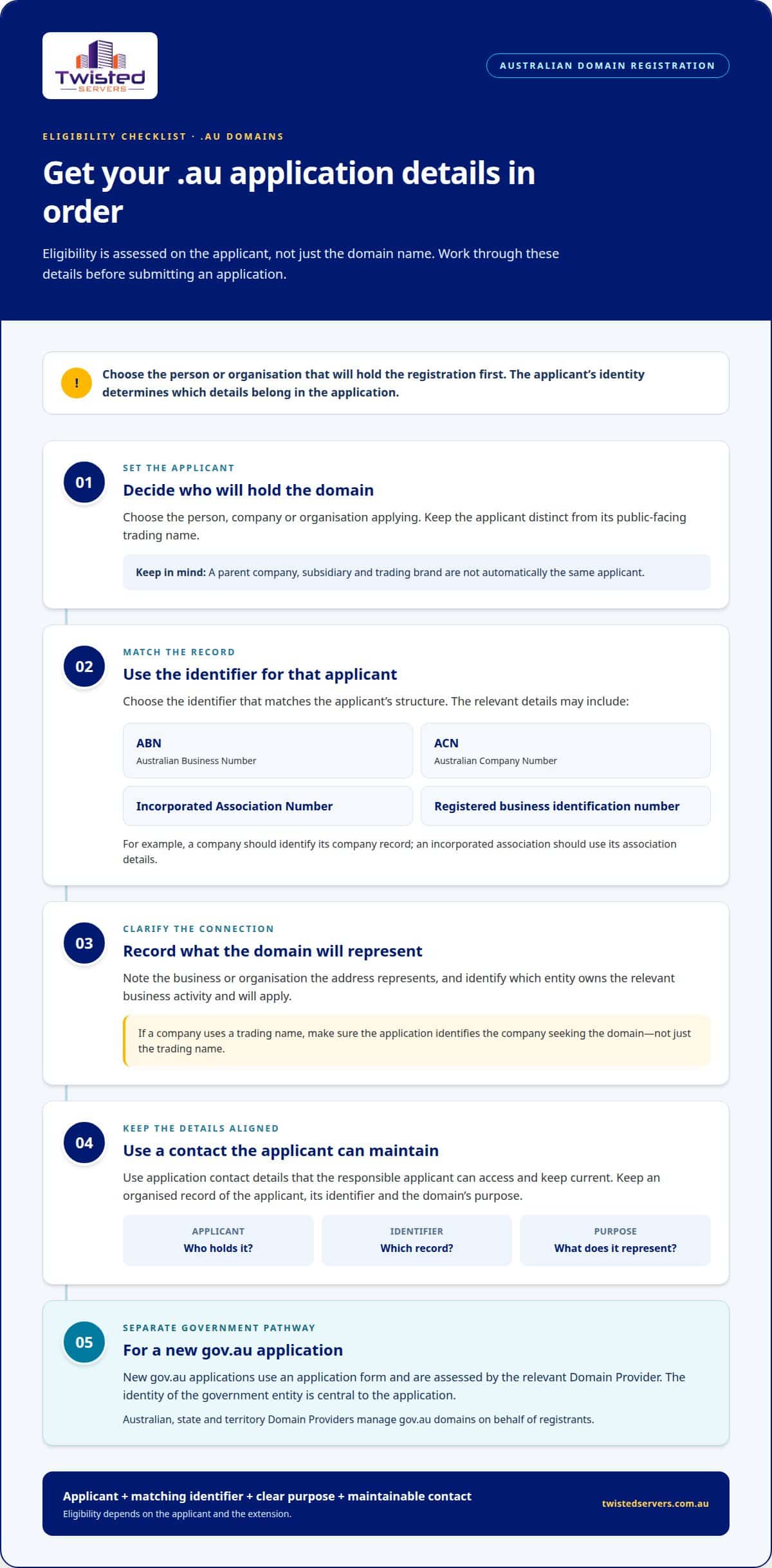
Eligibility is assessed based on the applicant, not just the domain name. Before preparing an application, decide which person or organisation will hold the registration. If a business uses a trading name, distinguish that public-facing name from the entity applying. Keeping these roles clear helps you choose the right application details.
Australian domain criteria recognise several types of applicant identifier, including an Australian Business Number (ABN), Australian Company Number (ACN), Incorporated Association Number or registered business identification number. The relevant identifier depends on the applicant’s structure. For example, an incorporated association should use its association details, while a company should identify its company record.
Use the identifier associated with the actual applicant. If the website represents a company, don’t use a director’s personal details as a substitute for the company’s identity. If an association is applying, keep its identification details separate from those of an individual office-holder. This helps keep the applicant and registration record consistent.
Before submitting, organise the details around the applicant:
- Applicant name: Decide which person, company or organisation will hold the domain.
- Identifier: Match the applicant with its relevant ABN, ACN, Incorporated Association Number or registered business identification number.
- Domain purpose: Record the business or organisation the address will represent.
- Application contact: Use contact details that the responsible applicant can access and maintain.
If a business or organisation has several related entities, identify which one owns the relevant business activity and will apply. A parent company, subsidiary and trading brand are not automatically the same applicant. For instance, if a registered company uses a trading name, make sure the application identifies the company seeking the domain, rather than assuming the trading name is the legal applicant.
Government applicants follow a separate assessment route. New gov.au applications use an application form and are assessed by the relevant Domain Provider. The identity of the government entity is central to the application, not just the wording chosen for the address. Australian, state and territory Domain Providers manage gov.au domains on behalf of registrants.
Keep a record of the chosen applicant, its relevant identifier and the domain’s purpose. This gives the person preparing the application a clear reference and helps prevent details from being mixed across related entities. Eligibility depends on the applicant and extension, so resolve those details before applying instead of relying on the domain name alone.
Australian domain extensions
The ending of a domain name is its extension. For an Australian organisation, it can signal a local connection, identify a commercial purpose or indicate government status. The main options discussed here are .au, .com.au, .net.au and .gov.au. A .com domain is another option, but it is not an Australian country-code extension.
The .au top-level domain was introduced in 1986 and has served Australian and global internet users for four decades. A short address ending in .au can communicate an Australian connection. The more specific .com.au and .net.au endings also sit within the .au domain space, but they are not interchangeable with every other extension. Your organisation’s purpose and eligibility help determine which is suitable.
- .au: A direct Australian domain extension for eligible applicants with an Australian connection.
- .com.au: A commercial option associated with businesses and commercial activity in Australia.
- .net.au: Another Australian extension, with commercial-entity requirements for business applicants.
- .gov.au: Reserved for Australian, state and territory, and local government entities.
- .com: A non-country-code option that can be registered for 1 to 10 years.
Registration periods differ by extension. Australian .com.au and .net.au domain names can be registered for 1 to 5 years. By contrast, .com domain names can be registered for 1 to 10 years. These periods matter when planning renewals: the licence term you select affects when the domain needs attention again. A domain is a subscription, not a permanent purchase.
Consider your audience as well as the name. If Australian customers are your main audience, a .au ending can make the local connection clear. A business choosing between .com.au and .net.au should consider which better reflects its identity and activity. Government entities follow a different path: .gov.au applications use a form and are assessed by the relevant Domain Provider.
Before submitting a registration, shortlist an extension and check that the name is available. Then confirm the applicant meets the extension’s requirements and choose a registration term. This order helps you avoid preparing an application around an unsuitable ending and keeps the domain aligned with your organisation’s name and intended use.
No single extension suits every Australian user. A business may prioritise a recognisable commercial address, while an eligible government body requires a government extension. Someone choosing .com may prefer its longer available registration term or broader reach, as seen with dedicated community platforms like storiedtails.com. The right choice depends on purpose, applicant eligibility, audience and renewal planning.
Once you’ve chosen an extension, record the renewal date and keep the domain details current. Renewal arrangements can vary by extension, so check the requirements for your domain. Other domain registrations need to be renewed to avoid release back into the pool. The extension matters beyond the appearance of your web address.
Comparing first-year registration prices
There is no single first-year price for every Australian domain. The amount depends on the extension and registration term, so compare like with like. A .com.au registration and a .com registration are different choices with different available registration periods. The extension alone doesn’t tell you the total cost for the first year.
For a fair comparison, record the price for the first registration period, then check the period it covers. Australian .com.au and .net.au domain names can be registered for 1 to 5 years. A .com domain can be registered for 1 to 10 years. A price covering several years is not directly comparable with a first-year amount.
Use this short checklist when reviewing a quoted amount:
- Extension: Compare the same ending, such as .com.au with .com.au.
- Term: Confirm whether the amount covers one year or a longer period.
- First year: Separate the initial registration charge from later renewal costs.
- Renewal: Record the renewal amount and when the subscription must be renewed.
Plan for renewal even if you’re focused on the first year. A domain registration is a subscription, not permanent ownership. If it isn’t renewed, it can be released for someone else to claim. For a .com.au domain, note the selected term and renewal date. For .com, the available term can be longer, so check which period the quoted amount covers.
The extension also determines which registration route applies. For example, .gov.au is reserved for Australian, state and territory, and local government entities. Government applications follow a different process from business registrations. Compare prices only after identifying the extension that suits your applicant and intended use. Otherwise, a low first-year price may refer to an unsuitable option.
When reviewing a price, check whether it covers a new registration or renewal of an existing domain. These are separate stages in the domain subscription. Keep the first-year price, term length and renewal amount together instead of relying on a headline figure alone. This gives you a clearer view of the cost over the period you select.
Prices depend on the extension, registration term and registration details, and are provided after a quote request. This section does not compare specific first-year or renewal prices. Compare the same extension and term before deciding. For instance, compare a one-year .com.au quote with another one-year .com.au quote, not with a multi-year .com total. Keep the renewal date visible so the next charge doesn’t come as a surprise.
Australian presence for .au domains
Assessing Australian presence starts with identifying the entity behind the application. The brand name, website audience and applicant may all be different. Keep them separate in your records. For example, a business may trade under a public brand while another entity operates it. Consider the application in relation to the entity seeking the domain, not just the name customers see.
Next, describe the connection between that applicant and its business activity in Australia. Focus on the applicant’s own circumstances. An Australian customer base alone may not explain the applicant’s business connection. Similarly, a domain name containing an Australian place name doesn’t establish the applicant’s circumstances. The key distinction is between evidence about the business and wording chosen for the address.
Use a simple internal review before applying:
- Identify the applicant: Write down the entity that will hold the domain.
- Describe its business: Summarise what that entity does and how its activity relates to Australia.
- Separate the brand: Note whether the public trading name differs from the applicant’s name.
- Check consistency: Ensure the application describes the same applicant throughout.
This review is especially useful for groups with related entities. A parent company, subsidiary and trading brand may share a website or public identity, but remain distinct in business records. Decide which entity is applying before relying on another group member’s Australian activity. This avoids presenting a broad group connection as if it automatically describes the applicant’s own business.
Consider the domain’s purpose too. If the address will represent a specific Australian operation, describe that operation clearly. If the applicant’s business spans several markets, distinguish its Australian activity from its wider audience. Explain the applicant’s connection accurately, without treating a slogan, audience location or domain wording as a substitute for business context.
Keep the explanation factual and consistent with the applicant’s actual activities. Don’t overstate a connection or describe a planned future operation as an existing one. If the business structure or trading arrangements are complex, decide internally which entity the domain will represent before applying. Clear ownership and a clear business description make the application easier to assess.
Australian presence depends on the applicant’s circumstances, not simply the impression created by a web address. A concise account of the applicant, its business and its Australian connection gives the registration process relevant context. Use the same entity and description throughout the application, and avoid mixing details from a related brand or organisation.
Twisted Servers: Domain Name Registration
Twisted Servers offers Domain Name Registration for individuals and businesses securing an Australian web address. It’s a practical next step once you’ve chosen a suitable name and extension and understand the eligibility requirements. A domain gives your website a clear address and can also form part of a business email address.
If you’re planning an online presence alongside other infrastructure, Twisted Servers also provides Game Server Hosting, VPS Hosting and Dedicated Server Hosting. The right option depends on what you’re setting up: a domain name, a website, or server resources for an application or gaming community.
For help with your domain registration needs, contact Twisted Servers.
Make your next online step count
Your domain can be the starting point for a broader online presence. Once you’ve settled on a name, consider what needs to sit behind it: a website, a virtual server or a dedicated environment. This helps you plan beyond registration without committing to services you don’t need.
Twisted Servers offers Domain Name Registration, as well as Game Server Hosting, VPS Hosting and Dedicated Server Hosting. If you’re planning domain registration in Australia and want to discuss the next step, talk with Twisted Servers about your domain.
You have the essentials to make an informed choice. When you’re ready, take the next step with a domain that fits your plans.
Frequently Asked Questions
What is a domain name?
A domain name is the readable address people enter to reach a website, such as a business name followed by an extension. It directs visitors to the website’s online location without requiring them to use a numerical internet address. A business can also use its domain in email addresses. Registration secures the address for the registration period, but doesn’t provide intellectual property protection for the name.
What will a .com.au website domain do for my business?
A .com.au address gives your business a recognisable web address and signals an Australian connection to visitors. It can also provide the domain for business email, helping keep your website and email identity consistent. For example, customers may recognise an address that matches your business name. Registration doesn’t create a website or protect the name as a trade mark.
Will my domain expire?
Yes. A domain registration is a subscription that needs renewal to keep the address registered to you. If you don’t renew it, the domain can be released for someone else to claim. Record the renewal date and account details, and make sure renewal notices reach an email address you can access. A registry grace period may apply after expiry, but don’t rely on it instead of renewing on time.
How much does it cost to register a .com.au domain in Australia?
The first-year amount depends on the registrar and registration term. Compare quotes for the same .com.au extension and term, then distinguish the initial registration charge from the renewal amount. A multi-year registration total isn’t directly comparable with a one-year price. Check what period the quoted amount covers and note the renewal date to plan for the next subscription period.
What are the eligibility requirements for registering a .com.au domain?
A .com.au applicant must meet Australian eligibility criteria. An applicant may be a local resident or a business or company registered in Australia. A business applying for .com.au must be a commercial entity and have an ABN or ACN. Other relevant Australian identifiers include an Incorporated Association Number or registered business identification number. The applicant’s details should match the entity seeking the domain licence.
What documents or Australian presence are needed to register a .com.au domain?
Applicants for .com.au need a relevant Australian business identifier, such as an ABN, ACN, Incorporated Association Number or registered business identification number. A business applicant must be a commercial entity with an ABN or ACN. Keep the identifier details ready for registration. For a direct .au domain, the applicant must also demonstrate a link to Australia in their business.
How do I register a .com.au domain name in Australia?
Choose a name that matches your business identity, then search for availability using the .au Domain Administration Ltd (.auDA) search. Confirm that the applicant meets .com.au criteria and has the relevant identifier. Then submit the registration through a registrar or reseller listed on the .auDA website. Select the registration term and keep the account and renewal details accessible to the person responsible for the domain.
How do .com.au, .au, .net.au and .org.au domains differ?
.com.au and .net.au are Australian extensions with commercial-entity requirements for business applicants. A direct .au domain requires an Australian connection in the applicant’s business. The .org.au ending has an organisation-focused label, so don’t assume its eligibility criteria match those for commercial domains. Compare the extension’s purpose with the applicant’s status, then check the applicable requirements before submitting an application.
Disclaimer
Game titles, trademarks, logos and related assets are the property of their respective owners. Twisted Servers is an independent hosting provider and is not affiliated with or endorsed by the developers or publishers of the games mentioned unless otherwise stated. Information is provided as a general guide and may change as games, software and hosting services are updated.

