
Recommended Services


Supported Scripts

Hosting a dedicated server for Star Wars Jedi Knight: Jedi Academy requires understanding hardware allocation, server configuration files, and network port routing. Before you spend on hardware or a monthly plan, settle three decisions: whether a home PC can carry your player count without wrecking your upload path, whether server.cfg will bind on an address friends can actually reach, and whether Australian infrastructure is worth it for the ping you need in lightsaber combat. Australian gamers can deploy dedicated infrastructure locally through providers like Twisted Servers to achieve low-latency competitive gameplay.
Key Takeaways: Host your Jedi Academy server on dedicated infrastructure to ensure 99% uptime and low-latency lightsaber combat that residential internet connections cannot support.
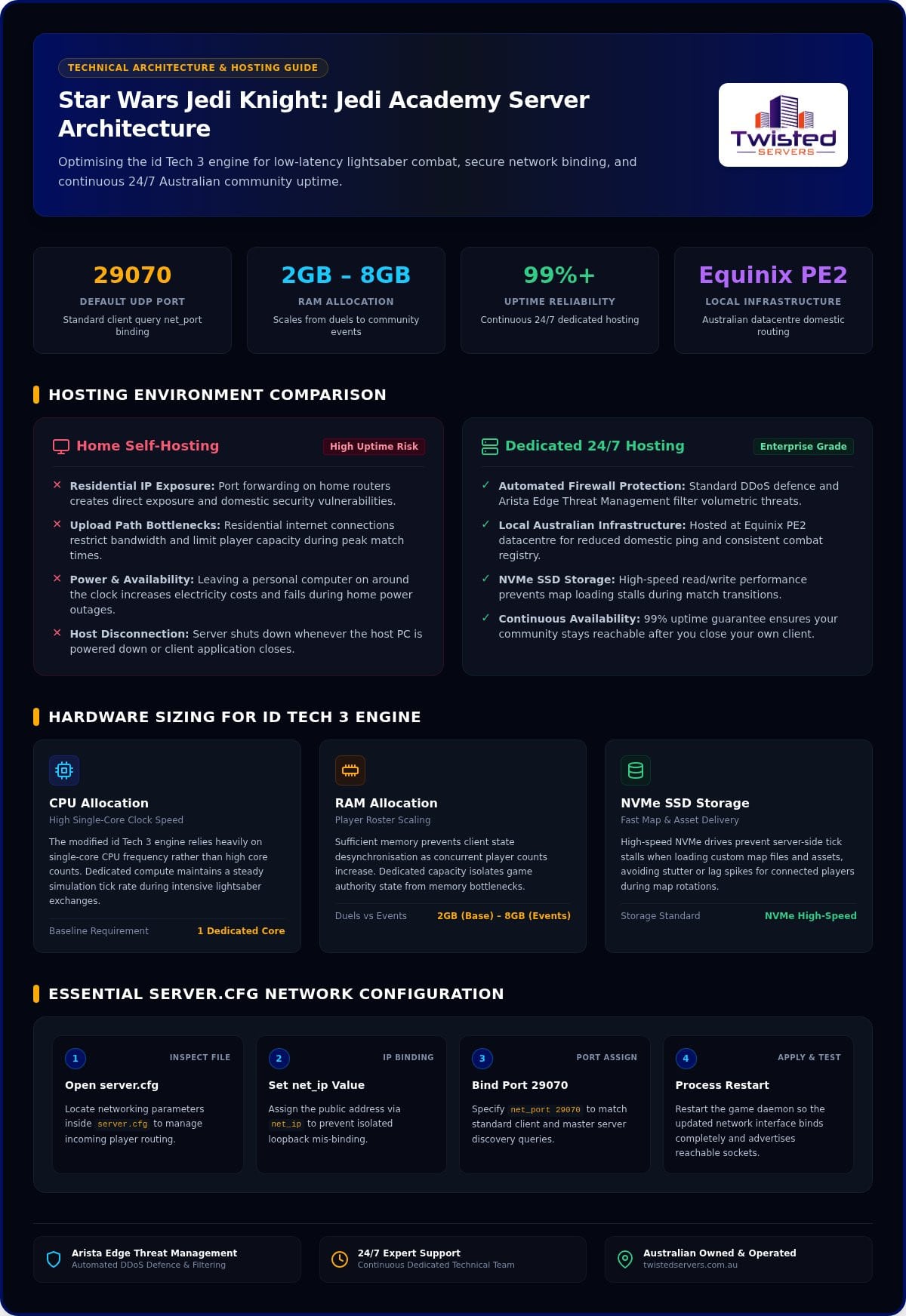
- Allocate at least 1 CPU core and 2GB RAM for basic duels or 8GB for events.
- Self-hosting is not worth it if you cannot risk exposing your residential IP address.
- Choose dedicated hosting with NVMe SSDs to prevent map load stalls during player transitions.
- Configure your server.cfg with net_port 29070 and net_ip to ensure external player connectivity.
Self-Hosting Trades Setup Cost for Uptime Risk; Dedicated 24/7 Stays Online
Picture three common nights on Jedi Academy. A quick LAN test with friends in the same room: a spare PC is enough. A public clan evening that must stay up after you log off: rent dedicated 24/7 capacity so home power cuts and upload caps stop ending the match. A community that also runs forums or download mirrors beside the game process: keep web traffic on separate hosting so a map spike does not stall the id Tech 3 tick.
Hosting on your local machine means running the server software on a spare personal computer. Dedicated 24/7 hosting relies on commercial data centres to run the game continuously.
Self-hosting avoids initial subscription costs, but your home internet connection limits player capacity. Port forwarding creates security risks on your home network. Leaving a machine on around the clock raises your electricity bill significantly.
Renting a dedicated environment removes those personal internet bottlenecks. Professional platforms feature automated firewall filtering to defeat volumetric attacks. A provider with local infrastructure keeps latency lower for your Australian player community.
Use fast hard drives (NVMe SSD storage) so map loads do not stall mid-session. Isolated hardware resources help stop clients drifting out of sync with the host simulation when player counts climb.
Structured multiplayer has always needed deliberate network design across platform releases; a System Link games list illustrates how console link play depended on planned LAN paths rather than casual home shares.
Managed hosting simplifies day-two work. You can drop in your preferred mod set through a web control panel instead of hand-editing every path on the shell. Jedi Academy does not use Steam Workshop; you install mods manually or with third-party tools, and a panel simply shortens that workflow.
For stable public play, choose dedicated hosting from Twisted Servers so your community stays reachable after you close your own client. More on this: Unmatched Australian Game Server Hosting.
Before you assume a home box is cheaper, add power draw and the risk of exposing your residential IP to the total.
Correct server.cfg Bindings Let Private Matches Accept Outside Players
A clean server.cfg is what lets players discover and join your private Jedi Academy match without fighting your own network. A dedicated environment still needs the right IP bind and the default UDP port 29070 open end to end.
- Open your configuration file and locate the networking parameters section within server.cfg.
- Set the main host address using the
net_ipcommand to define where incoming traffic lands. - Specify the port binding by entering
net_port 29070to match standard client queries. - Restart the server process so your new network definitions initialise completely.
Treat those binds as a named extension on a switchboard: if you only listen on a generic internal loopback, external players sit on a dead line. If you also publish community pages beside the game process, shared web hosting can keep those pages responsive without tying them to the match tick.
A dedicated public IP fits public hosts; an internal LAN address suits private testing. Correct parameters keep host and client simulation aligned. If connections fail, check network adapter bindings and confirm the process is not attached to an isolated interface.
One hosted-platform report shows how easy that mis-bind is. Writing in the pythonanywhere.com thread "Set up twisted on port 5000: Forums", one user shared:
"I got my invite today, and I’m trying to run my twisted chat server to test if PythonAnywhere support it well. I put the server to listening on interface: socket.gethostbyname(socket.gethostname()), port: 5000 and it gives a strange IP(10.122.89.215), I can’t connect with my client." (source)
Situation: the process bound via hostname lookup and landed on an isolated address. Fix: set explicit public net_ip / port values in config and restart so the service advertises a reachable endpoint. Result: clients stop chasing an internal-only interface, which is the same failure mode Jedi Academy private hosts hit when server.cfg never pins a public path.
Size CPU, RAM and NVMe to Your Roster and Monthly Budget
Star Wars Jedi Knight: Jedi Academy runs on a modified id Tech 3 engine. That legacy engine leans on single-core CPU frequency more than high core counts. Stable continuous hosting still needs enough RAM so rising player counts do not pull clients out of sync with the authority state. High-speed NVMe SSD storage shortens map load times for everyone connected.
Budget virtual environments often let background processes starve the main game thread. VPS hosting plans with dedicated compute keep tick rate steadier during heavy lightsaber exchanges.
| Hosting Tier | Recommended Specs | Target Usage |
|---|---|---|
| Basic Community | 1 CPU Core, 2GB RAM | Small duelling matches |
| Standard Clan | 2 CPU Cores, 4GB RAM | Mid-sized base setups |
| Enterprise Event | 4 CPU Cores, 8GB RAM | Large modded servers |
Match hardware to the roster you actually run. Basic resources suit simple duelling rooms. Larger servers with a detailed mod list (installed manually or through third-party tools) need extra RAM and faster storage. Local Sydney infrastructure gives Australian players a shorter path to the box.
Monthly cost tracks core count, memory, and bandwidth caps. For figures sized to your community, ask Twisted Servers for a personalised quote.
When Self-Hosting is the Wrong Technical Choice
A Jedi Academy process on your personal computer often collides with the rest of your household traffic. Pushing a public multiplayer session through a residential line puts clan traffic on the same path as Streaming and work VPNs.
Residential Broadband rarely has the headroom for peak inbound bursts without adding latency. Home links also drop or stall more often when several players join at once, which is when clients start disagreeing with the host simulation.
Consumer routers struggle with constant inbound UDP, which shows up as packet loss and hard disconnects. Residential plans do not include dedicated infrastructure, continuous power cover, or professional filtering. Leaving hardware on all day raises energy bills and publishes your home IP to the wider internet.
When you need consistent network behaviour, an Australian dedicated server platform is the stronger fit. Enterprise data centres bring redundant power, fast hard drives, and DDoS protection home setups lack. Keep self-hosting for casual solo tests; move public community matches onto dedicated infrastructure.
Tip: Hosting on a home setup often causes connectivity dropouts due to dynamic IP changes and non-guaranteed uptime.
Australian Infrastructure at Equinix PE2 Cuts Domestic Match Ping
Placing your Jedi Academy server inside Australia cuts delay for local players in a way overseas routes cannot match.
When packets cross undersea cables, fast lightsaber exchanges pick up lag you feel on every swing. Domestic hosting keeps traffic onshore so response times stay usable in ranked or clan play. Based in Australia, Twisted Servers focuses on customisable game server hosting across vanilla and heavily modded setups.
Physical distance sets your ping floor. Servers in Perth sit at Equinix PE2, a data centre with fast, reliable connectivity and strong physical security. That site gives Western Australian players a short path and still routes cleanly toward the eastern states. Equinix PE2 pairs redundant power with high-tier bandwidth providers so competitive nights are less likely to end in surprise dropouts.
Tight combat feedback depends on that short path plus storage that keeps up: NVMe SSD volumes load maps quickly even when you run a heavy manual mod set. High-speed local routing removes extra hops that ruin hit registration. For Australian communities, in-country placement is a practical operations choice, not a branding slogan.
Support speed matters beside raw ping. A commenter in the disboard.org thread "Twisted Gaming | DISBOARD: Discord Server List":
"Admins are quick to respond and honest when servers are down." (source)
Situation: a public community hits an outage window. Response: staff reply quickly and state the facts. Effect: players trust the room enough to wait out the fix instead of scattering, which is as important as the 99% uptime guarantee on the hardware side.
Frequently asked questions
What files and patches are needed?
You need the base game along with the official point release patch installed on your system. Maintained game files keep your client aligned with the server on custom maps and reduce avoidable disconnects.
How do I configure server.cfg for a private server?
Place server.cfg in your base folder and define parameters such as sv_hostname (the server name players see), net_ip, net_port, and rconPassword. A clear rcon password locks down administrative control as soon as the process starts.
Which ports must be forwarded on my router?
Open UDP ports 29070 through 29073 on your router so player traffic can reach the machine. Local Australian hosting can handle upstream routing for you once those ports are correct on self-hosted tests, or when you move the process onto datacentre networking.
How do I configure the server shortcut?
Edit your executable shortcut target line to include launch commands such as +set dedicated 2 and +exec server.cfg. Those parameters force the binary to boot as a dedicated server instead of a local client.
How can I test if friends can connect?
Share your public IP address and port, or confirm the server appears in the master browser. Hosting from the Equinix PE2 data centre in Perth gives your players a short domestic path backed by a 99% uptime guarantee.
Secure Your Jedi Academy Server Hosting in 2026
The same decisions you opened with still close the loop: home self-hosting only when your roster and risk tolerance allow it, a server.cfg that binds on a public path, hardware sized to real player counts, and Australian placement when ping decides fights.
Local infrastructure reduces delay for your multiplayer community. Hosting inside Australia shortens response times and steadies intense lightsaber rounds.
High-performance environments with a 99% uptime guarantee, NVMe map loads, and assigned hardware allocations keep peak-hour play coherent when the room fills. Slot counts and resource tiers drive monthly cost, so line those up with how many players you actually run.
Request a personalised quote sized to your community, explore broader game hosting options, or contact the team to bring your dedicated environment online.
Disclaimer
Game titles, trademarks, logos and related assets are the property of their respective owners. Twisted Servers is an independent hosting provider and is not affiliated with or endorsed by the developers or publishers of the games mentioned unless otherwise stated. Information is provided as a general guide and may change as games, software and hosting services are updated.

